


DTRO (Disc Tube Reverse Osmosis) uses a disc-tube membrane configuration with open hydraulic passages suited to certain high-fouling wastewater applications. Like all RO processes, however, it remains constrained by osmotic pressure, membrane properties, and feedwater chemistry.
Recovery rate (%) = Permeate flow / Feed flow × 100
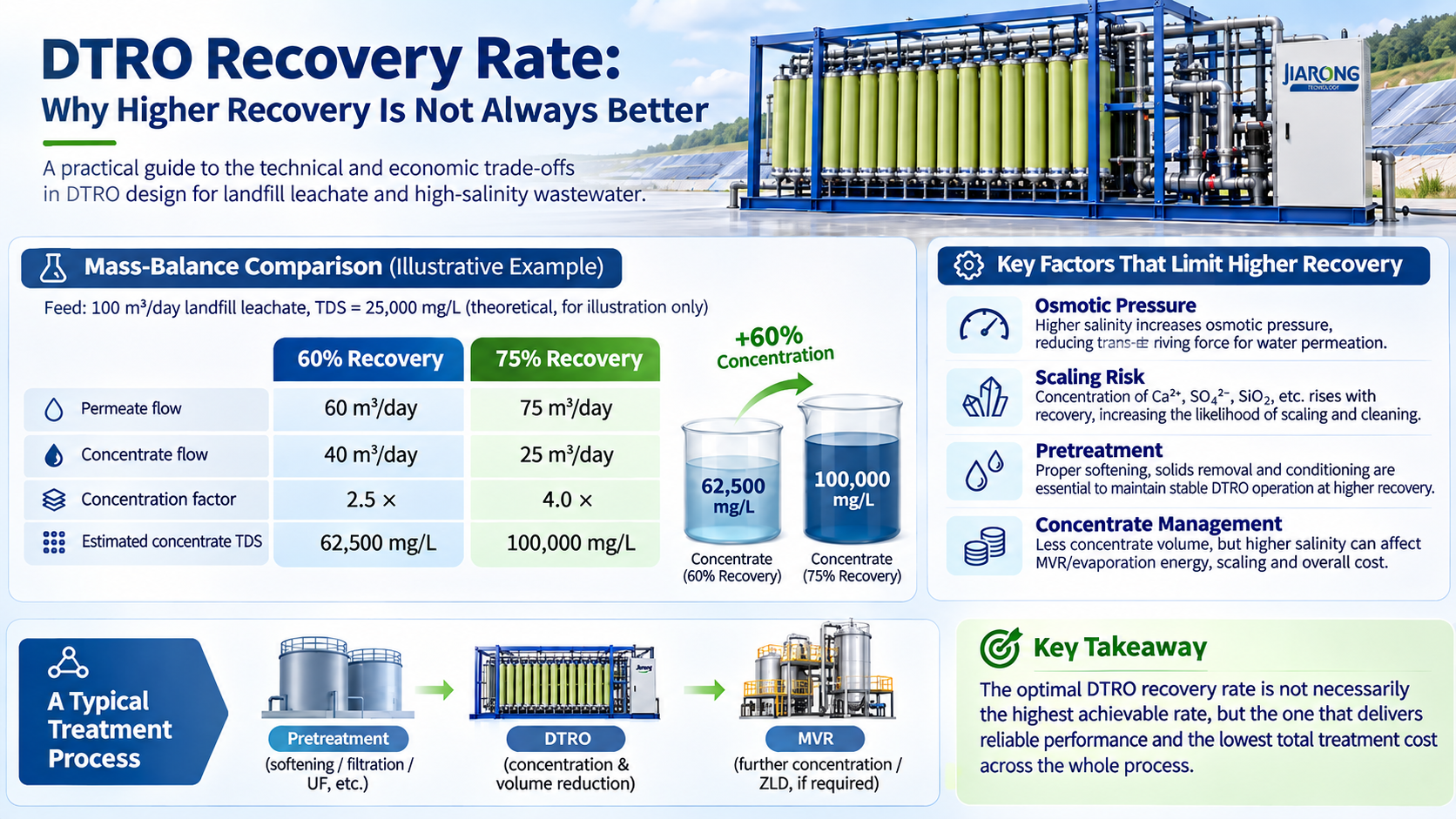
For a 100 m³/day feed, 60% recovery produces 60 m³/day of permeate and 40 m³/day of concentrate. Raising recovery to 75% reduces concentrate to 25 m³/day—a 37.5% reduction in liquid volume.
But dissolved salts do not disappear: most remain in the concentrate.
Assume 100 m³/day of landfill leachate at 25,000 mg/L TDS. For illustration, neglect salt passage, precipitation, and density changes.
| Parameter | 60% Recovery | 75% Recovery |
|---|---|---|
| Permeate | 60 m³/day | 75 m³/day |
| Concentrate | 40 m³/day | 25 m³/day |
| Concentration factor | 2.5× | 4.0× |
| Estimated concentrate TDS | 62,500 mg/L | 100,000 mg/L |
The 75% scenario sends 15 m³/day less liquid downstream, but the calculated concentrate salinity is 60% higher.
These values are theoretical—not a claim that 75% recovery is achievable at this feed TDS. Actual feasibility depends on ion composition, membrane limits, temperature, pressure, and scaling potential.
Water flux in RO can be represented approximately as:
Jw = A(ΔP − Δπ)
Here, ΔP is the hydraulic pressure difference and Δπ is the osmotic pressure difference.
As brine salinity rises, osmotic pressure generally increases, leaving less net driving force for water transport.
Higher-pressure DTRO equipment can extend the operating envelope, but a module's pressure rating is not a recovery guarantee.
Pump energy, membrane flux, concentration polarization, and operating margins must also be evaluated.
Engineering takeaway: Maximum operating pressure is an equipment specification. Achievable recovery is a system-level engineering result.
As recovery increases, the concentrations of calcium, sulfate, silica, and other constituents rise. Depending on pH and ionic composition, salts may precipitate on membrane surfaces.
Scaling can reduce flux, increase cleaning frequency, and shorten operating life.
DTRO's open-channel design may help manage certain fouling conditions compared with conventional spiral-wound membranes. It does not eliminate inorganic scaling.
Two feeds with the same TDS can behave very differently; full ionic analysis matters more than a single conductivity value.
Engineering takeaway: Recovery targets should be determined by water chemistry and scaling potential, not membrane pressure alone.
Pretreatment should be designed around the actual contaminants and recovery target, not selected as a standard accessory.
Depending on the feed, it may include:
Softening or chemical conditioning for hardness and scaling control.
Solids removal, flotation, filtration, or ultrafiltration for suspended matter and colloids.
Oil and grease control where industrial contaminants are present.
Temperature management and equalization where feed quality varies.
Pretreatment improves stability but also adds chemical consumption, sludge management, CAPEX, and OPEX.
The right design balances those costs with the benefits of higher recovery.
Engineering takeaway: A well-designed pretreatment system can be more valuable than simply increasing membrane operating pressure.
Suppose the residual DTRO concentrate is treated by MVR (Mechanical Vapor Recompression) evaporation.
At 330 operating days per year:
60% recovery: 40 × 330 = 13,200 m³/year entering MVR.
75% recovery: 25 × 330 = 8,250 m³/year entering MVR.
The higher-recovery scenario reduces annual MVR feed by 4,950 m³.
Yet that feed is much more saline.
Higher salt concentration may affect boiling-point elevation, scaling, heat transfer, materials selection, and residual brine handling.
Evaporation energy and operating costs will not necessarily decline in direct proportion to feed volume.
Similarly, DTRO alone does not constitute Zero Liquid Discharge (ZLD).
A ZLD design must manage the final liquid residue and solids, often through additional thermal or separation steps.
Membrane and evaporator duties should be optimized together.
Engineering takeaway: Reducing concentrate volume is valuable only when the additional membrane treatment costs and downstream operational consequences are considered.
A realistic comparison of feasible recovery scenarios should include:
Membrane-system CAPEX, pressure rating, and electrical load.
Pretreatment chemicals, equipment, and sludge disposal.
Membrane cleaning, replacement, downtime, and system availability.
MVR/MEE evaporation, crystallization where necessary, and final residue management.
Annualized total treatment cost under the same feedwater and performance assumptions.
For example, a more aggressive membrane recovery target may save evaporation capacity but require additional softening, higher-pressure pumping, and more frequent cleaning.
The economically optimal point can therefore be below the maximum technically achievable recovery.
Start with representative feedwater data:
Average and peak flow
TDS, conductivity, and pH
COD and ammonia
Calcium, magnesium, sulfate, silica, and alkalinity
Suspended solids, oil and grease
Operating temperature
Confirm the required permeate quality and legal concentrate-disposal route.
Then compare feasible recovery scenarios using membrane and scaling calculations, the full treatment-train mass balance, and lifecycle economics.
For complex or highly variable leachate, pilot testing may be needed to validate performance.
What is a typical DTRO recovery rate?
There is no universal number. Recovery depends on wastewater composition, pretreatment, operating pressure, temperature, membrane configuration, and discharge requirements.
Can high-pressure DTRO always reach 75% recovery?
No. A high pressure rating does not overcome all osmotic and scaling limits. The 75% scenario above is illustrative only.
Does higher DTRO recovery always reduce ZLD cost?
No. It lowers liquid volume but raises brine concentration and may increase upstream and downstream treatment costs.
Does DTRO require pretreatment?
Yes. The type and extent depend on wastewater characteristics, scaling risk, and membrane operating requirements.
At Jiarong Technology, we evaluate DTRO and STRO systems within the complete wastewater treatment process, including pretreatment, membrane concentration, and where appropriate, MVR-based concentrate management.
For landfill leachate and high-salinity industrial wastewater, our focus is on technically feasible recovery, stable operation, and whole-plant economics—not a headline recovery figure.
The optimal recovery rate is not necessarily the highest achievable rate. It is the one that delivers reliable performance at a sustainable total treatment cost.
Share your water analysis, treatment capacity, discharge targets, and concentrate-management requirements with Jiarong's engineering team for a preliminary technical discussion.
Jiarong Technology | DTRO · STRO · Landfill Leachate Treatment · High-Salinity Wastewater · ZLD Solutions
Share your water quality data and discharge requirements, we'll help assess a feasible and stable treatment approach
Submit